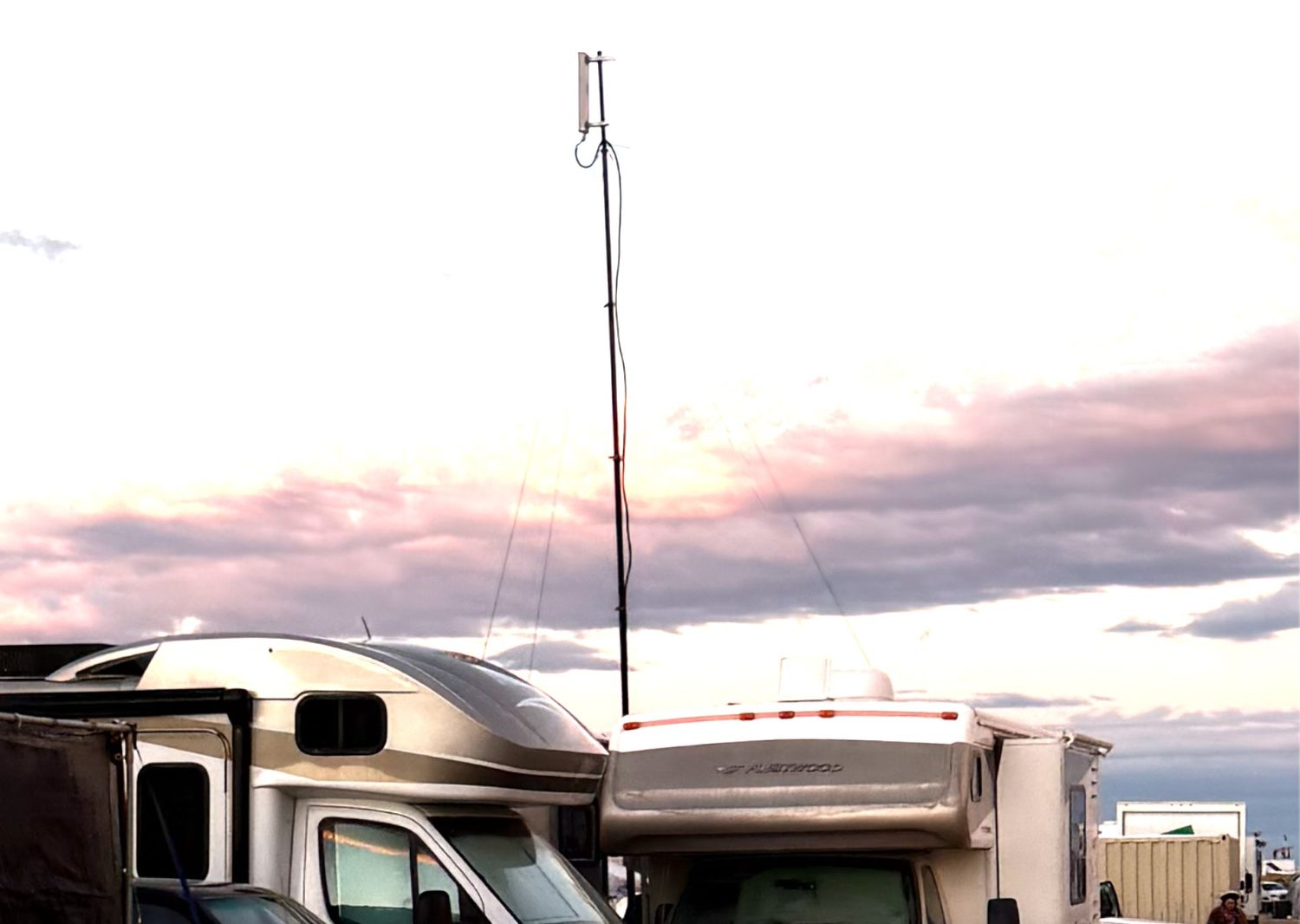
The challenge: 70,000 people, zero infrastructure
Private 5G usually gets sold as a construction project — six figures of budget, a year of build, permits and trenching before anyone makes a call. We wanted to know what one radio could actually do without any of that, so we took it somewhere with nothing to lean on.
Burning Man has no cell service. It is 70,000 people camped on a dry lakebed in the Nevada desert: no power lines, no internet, no towers, and alkali dust in everything. If a network holds there, it will hold on a substation yard or a campus.
One radio, one antenna, and a mast on a trailer hitch — running on sunlight.
The build
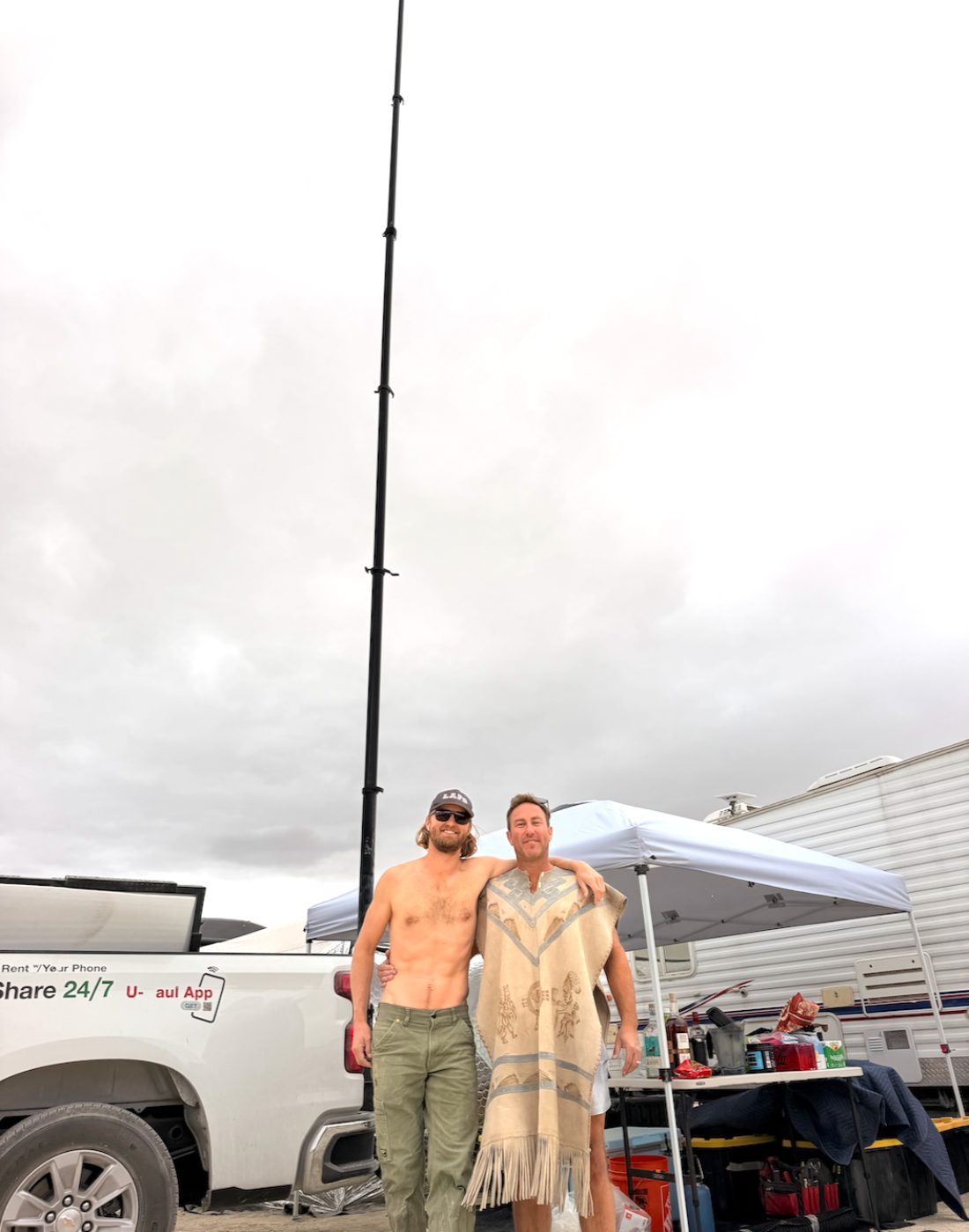
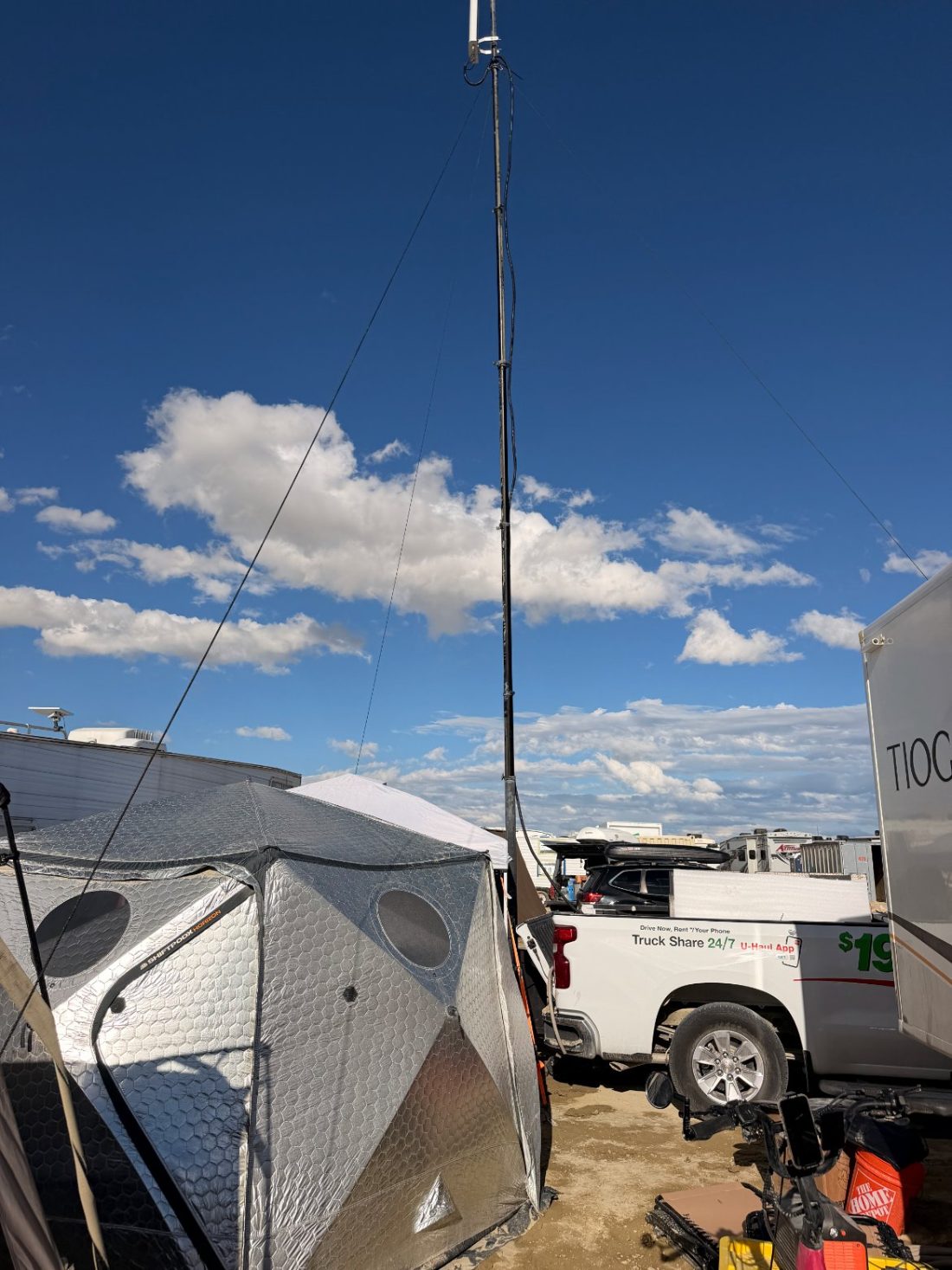
Everything ran off a single 90° sector antenna on a Critical Tech Solutions RATT, a quick-setup telescopic mast that mounts to a standard vehicle hitch — which is what made a two-person setup possible. Guy-wired and anchored into the playa with ¾″ lag bolts, it carried the antenna about 35 ft up and held through sustained 30 mph winds without adjustment.
Power was 1,280 watts of solar into a 48-volt lithium battery system. The uplink was Starlink Performance on an unlimited Roam plan. No grid, no fiber, no generator.
The brains: Ataya Chorus
A cell network needs more than a radio. It needs the software that decides which devices may join, keeps each one’s traffic private, and sends it out to the internet. Phone companies run that part on racks of servers in climate-controlled buildings. At Burning Man it ran on Ataya Chorus, built right into the MOSO radio.
That is a big part of why the whole build fit on a trailer hitch. There was no server rack at camp, no cooling, and no engineer typing in settings. We powered the radio up, it found Chorus in the cloud over Starlink, and it set itself up.
Running it was the easy part. Every SIM, eSIM, and device on the network lived in one Chorus dashboard in a web browser. Adding a device meant adding its SIM on a web page — no trip to the radio, no command line. From anywhere with an internet connection we could see who was connected, check how the network was holding up, and change settings.
It is secure by design, too. A device can only join if it carries a SIM we issued, so there is no shared password to leak the way there is with WiFi.
And it suited a satellite link. Chorus sends only small control messages up to the cloud; each device’s actual data leaves right at the radio. That keeps Starlink’s capacity for the people using the network instead of for network overhead.
The hard part of private 5G used to be the software. With Chorus, adding a device was as simple as adding a SIM on a web page, and the network ran itself all week.
How far it reached
Black Rock City is a surveyed grid, so these are real distances to real landmarks, measured against the published 2026 street map. The antenna sat at camp on the E ring at 4:00, aimed across the city at the Man.
Signal is what the handset showed. We read bars, not dBm — bar thresholds are carrier-defined and unpublished, and in crowded conditions the bar count can track signal quality rather than raw strength.
The video call is the number that counts here, not the bars.
Everything just joined. iPhones, iPads, Horizon 5G hotspots, and Peplink routers, over both eSIM and physical SIM — no special hardware, no custom builds.
This is not “better WiFi”
You are going to want to compare this to WiFi. Don’t. WiFi is legally forbidden from operating anywhere near this power — not outgunned, prohibited.
That is 79× more power. The WiFi bar is drawn slightly wider than true scale — at 4 W it would be thinner than a hairline.
This is not about WiFi gear being weak. The FCC will not let it go higher: 4 W is the ceiling on 2.4 GHz, on 5 GHz, and on 6 GHz. Adding new WiFi bands did not raise it. You cannot buy your way past it either — bolt a bigger antenna onto a WiFi radio and the rules make you turn the transmitter down by exactly what the antenna gained you.
Power is only half of it. The rest is what you are allowed to rely on.
The honest caveat
A 90° sector fires into a quadrant, not a circle. We aimed it from camp straight across the city, so what we demonstrated is reach, not city-wide coverage — outside that beam there was no service from us at all. The built city spans roughly 240° — three of these sectors on the same mast, and you cover all of it.
Three is the number worth carrying: you scale by angle, not by power, and sectors bolt onto a mast that is already standing.
Why the playa is the perfect torture test
This was not a stunt. Every condition that makes the playa miserable is a condition that takes real networks down — and the playa runs all of them at once, for six days straight.
What it means for your site
A radio on a 35-foot mast covering a mile of open ground maps directly onto substation yards, campuses, marinas, golf courses, and disaster staging areas. The difference is that most of those sites have power and a roof to work with.
One thing worth knowing: our measured signal came in well below what the textbook math predicted, because dust, vehicles, and crowds absorb signal that clean calculations ignore. Every real site costs you something. That is why we survey yours instead of quoting you a number off a datasheet.
The results
The bottom line
One radio and one antenna, on sunlight, reached clear across a city of 70,000 in the worst conditions we could find. If your property has power and somewhere to mount a radio, the question is not whether private 5G reaches — it is how much angle you need.
The field report adds the link-budget math, the measured-vs-calculated receipts, and the plan-view coverage map.