We took private 5G to Burning Man
One radio. One antenna. A mast on a trailer hitch, running on sunlight. No grid, no fiber, no carrier — and stock iPhones held video calls three-quarters of a mile across a city of 70,000 people. Here’s exactly how — and what it means for your sites.
Private 5G gets sold as a construction project: six figures of budget, a year of build, permits and trenching before anyone makes a call. We loaded one into a truck and drove it to Burning Man.
Black Rock City. 70,000 people, one week, a dry lakebed in Nevada.
No grid. No wired telecoms. No usable carrier service. Alkali dust in everything.
- MOSO 5GOD2 macro-class 5G radio, running Ataya Chorus
- 90° sector antenna aimed across the city
- 1,280 W of solar charging a lithium bank
- Starlink — the only uplink
- Critical Tech Solutions RATT telescopic mast on a trailer hitch, 35 ft
Two people raised the mast.
Stock iPhones held two-way video calls from camp to the Man — three-quarters of a mile across the city — and stayed connected past it.
No grid. No fiber. 30 mph wind.
Every number below says how we know it — measured, calculated, or estimated.
1 What we proved
Carrier infrastructure, not an access point. 20 W goes in, and the antenna focuses it into 316 W of radiated power — all of it on solar.
Math, off the equipment specsBars prove the downlink. A video call proves the uplink held too — the direction that decides whether your crew can push live video back.
We watched it happenThe signal we measured was far weaker than the clean calculation predicted — dust, vehicles and crowds all eat signal that textbook math ignores. Real sites always cost you something. Build margin in and you won’t be surprised.
What we saw vs. what the math saidAlkali dust, thermal cycling, 30 mph wind. Solar and lithium. No grid, no fiber, no adjustments.
We watched it happeniPhones, hotspots and a travel router all joined from a profile we sent them. Nothing to hand out, nothing to configure.
We tested three kinds of device2 How far it actually reached
2.1 Camp to the Man, on a stock iPhone
Black Rock City is a surveyed grid, so we can give you real distances to real landmarks instead of hand-waving. The antenna sat at camp on the E ring at 4:00, pointed across the city at the Man. Two readings, taken on a stock iPhone 17 Pro.
Distances measured against the published 2026 Black Rock City street grid. Signal is what the handset showed. We read bars, not dBm — bar thresholds are carrier-defined and unpublished, and in crowded RF conditions the bar count can track signal quality rather than raw strength.
The video call is the number that counts here, not the bars.
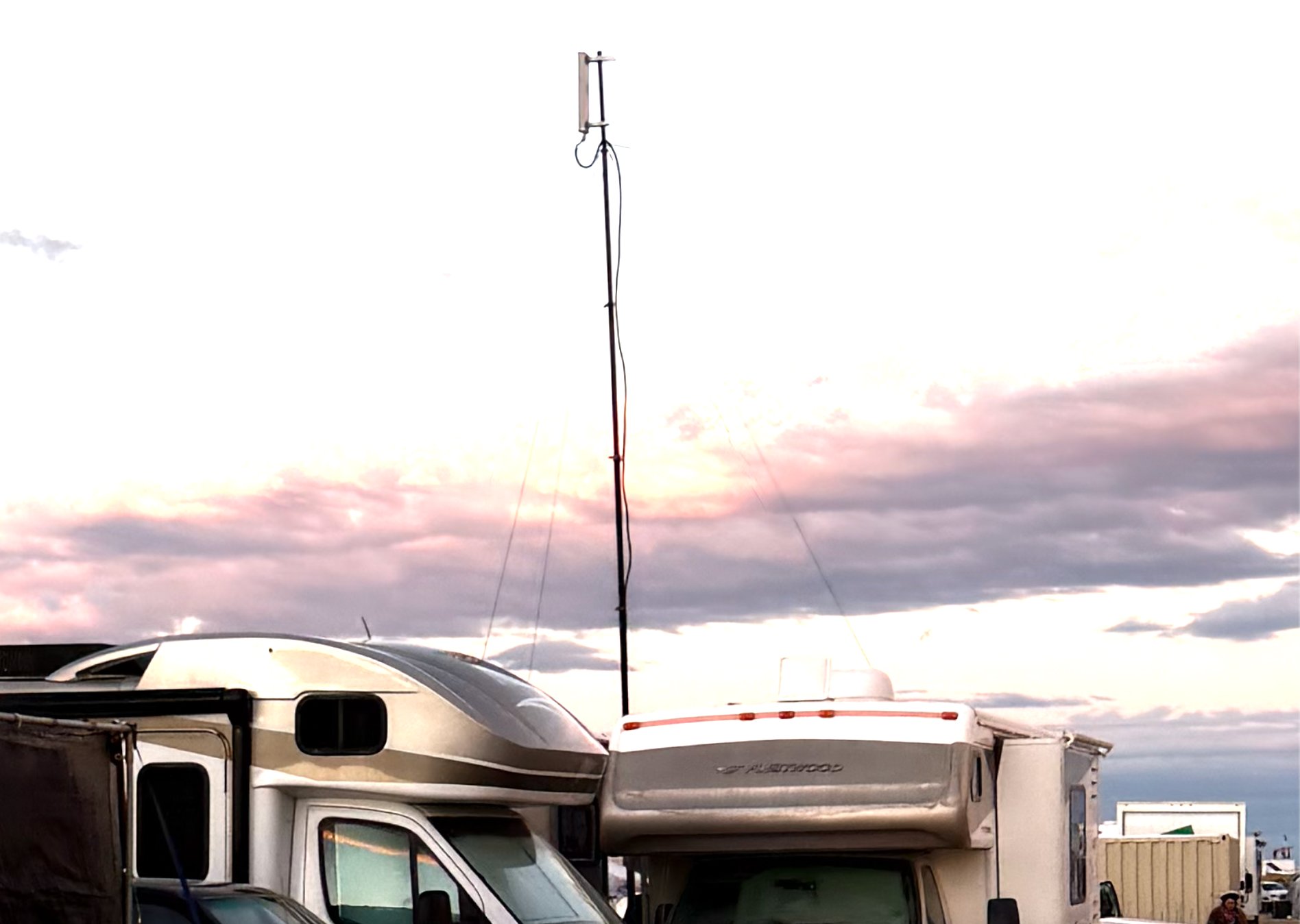
The installation at dusk. The Critical Tech Solutions RATT, a hitch-mounted telescopic mast, carries the 90° sector antenna roughly 35 ft up, guy-wired and lag-bolted into the playa, with coax running its length to the radio at the base. Raised by two people, on a camp with no grid connection and no permanent structure — and it held through 30 mph winds.
Plan view, drawn to scale from the published street grid. One 90° sector on a mast at 4:00 & E, aimed across the city at the Man — where the video calls held, 0.78 mi out. The Temple sits roughly 1.12 mi out and 23° off the beam’s center line, still connected. Note what the wedge does not reach: the camps nearest the mast sit behind the antenna, and about two-thirds of the city got nothing from us. Coverage is a wedge, not a circle. Signal is shown as the handset reported it. We did not instrument RSRP, and bar-to-dBm mapping is carrier-defined and unpublished, so no dBm figures are claimed.
2.2 The honest caveat: one antenna covers a wedge
Here’s the part most vendors leave out. A 90° sector antenna fires into a quadrant, not a circle — we mounted ours at 4:00 and E and aimed it dead center at the Man. So there are two halves to this result:
3 This is not “better WiFi.” Not close.
You’re going to want to compare this to WiFi. Don’t. WiFi is legally forbidden from operating anywhere near this power. Not outgunned — prohibited.
Here’s the whole thing in one picture. Radiated power is what a signal acts like after the antenna focuses it — the way a reflector turns a bulb into a spotlight.
That’s 79× more power. The WiFi bar is drawn a little wider than true scale — at 4 W it would be thinner than a hairline.
And this isn’t about WiFi gear being weak. The FCC simply won’t let it go any higher — 4 W is the ceiling on 2.4 GHz, on 5 GHz, and on 6 GHz. Adding new WiFi bands didn’t raise it.
You can’t buy your way past it either. Bolt a bigger antenna onto a WiFi radio and the rules make you turn the transmitter down by exactly what the antenna gained you. You end up at 4 W every time. So this isn’t a fair fight, and it was never going to be — WiFi isn’t permitted to play at this level.
And power is only half of it. The rest is what you’re allowed to rely on.
For anything that matters, those last two cards beat the power figures. You can’t promise your operations team coverage that runs on spectrum anyone else can walk into. Our spectrum is coordinated and our slice is assigned — which is why it holds up under real traffic, and WiFi doesn’t.
On unlicensed spectrum you have no protection at all. Whoever shows up next to you is allowed to, and you just live with it.
You can’t promise uptime on spectrum you don’t control4 What this means for your sites
Off-grid private 5G is ready right now. Not promising, not emerging — deployable today, by a small crew, on hardware you can order.
One radio on a 35-foot mast covers a mile or two of open ground. That’s the whole footprint, and it lands on exactly the property carriers serve worst.
Same story every time: coverage quits where your property gets interesting, and fiber costs more than the problem.
4.1 Will it work at your site?
Straight answer: the playa gave us one advantage — dead-flat terrain. It did not give us a clear path. 70,000 people parked camps, vehicles and art cars across it, and that’s where the excess loss went.
Campus, school or hospital. Buildings block, but far fewer than 70,000 people’s camps.
Golf course, estate or marina. Open ground, scattered structures. Closer to the playa than you’d think.
Substation or industrial yard. Open, low clutter. Better than the playa.
Wooded corridor or treed course. Foliage costs signal the playa never charged for.
Hills, ridges or ski terrain. Relief blocks in a way flat clutter doesn’t.
Dense urban. A different class of obstruction entirely.
Forget the radius. Radio count comes down to your clutter and your buildings — and an RF survey answers that in a week.
5 The entire build
Two people and a trailer hitch. Every item below is something a normal cell site needs and this one didn’t.
The mast is the Critical Tech Solutions RATT, a field-swappable rapid-deploy unit that drops onto a standard trailer hitch — and that hitch is the whole reason two people can put it up. Guy-wired, ¾″ lag bolts driven into the playa, antenna at about 35 ft. It held 30 mph sustained wind without a single adjustment. Height is the biggest lever you have on coverage, so a mast that sways or walks its anchors takes your coverage with it.
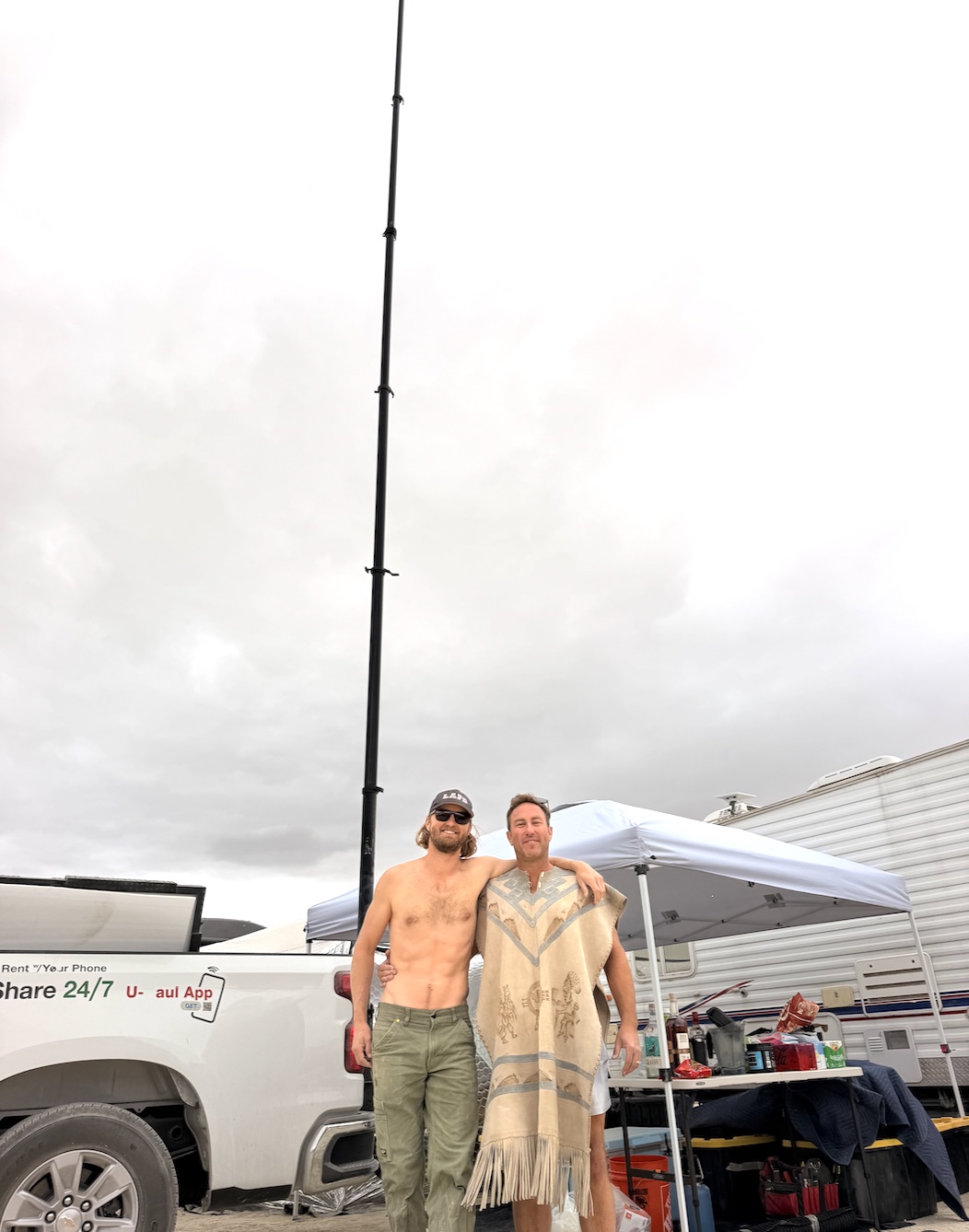
The whole deployment crew. The mast behind them is fully extended and guyed — raised by these two, off a trailer hitch, with no lift equipment and no contractor. That is the entire labor requirement for a network that carried video calls three-quarters of a mile.
Nothing on the client side was special. Stock iPhones and iPads, Horizon 5G hotspots, and a Peplink BR1 Mini 5G in an external MAX housing, on both eSIM and physical SIM. The iPhones are the whole argument: your network can serve the phone that’s already in your crew’s pocket.
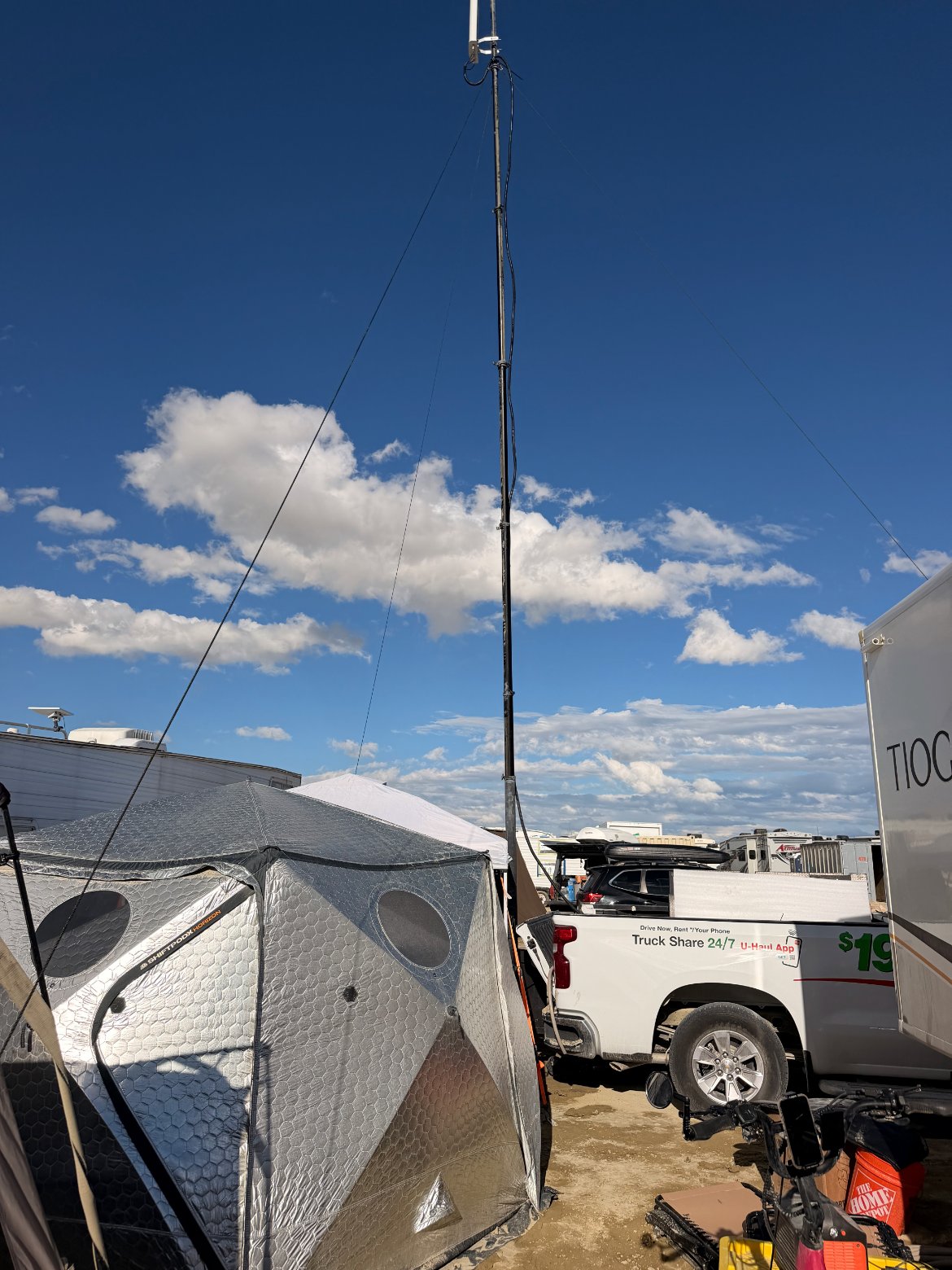
Camp-level view. The entire network — radio, backhaul and power — occupied a footprint about the size of a work vehicle, run by the same two people who raised the mast.
5.1 The brains: Ataya Chorus
A cell network needs more than a radio. It needs the software that decides which devices may join, keeps each one’s traffic private, and sends it out to the internet — the part phone companies run on racks of servers in climate-controlled buildings. Here it ran on Ataya Chorus, built right into the MOSO radio.
That is a big part of why the whole build fit on a trailer hitch. No server rack at camp, no cooling, no engineer typing in settings. We powered the radio up, it found Chorus in the cloud over Starlink, and it set itself up.
Running it was the easy part. Every SIM, eSIM, and device on the network lived in one Chorus dashboard in a web browser. Adding a device meant adding its SIM on a web page — no trip to the radio, no command line. From anywhere with an internet connection we could see who was connected, check how the network was holding up, and change settings.
Secure by design. A device can only join if it carries a SIM we issued, so there is no shared password to leak the way there is with WiFi.
Built for a satellite link. Chorus sends only small control messages up to the cloud; each device’s actual data leaves right at the radio. That keeps Starlink’s capacity for the people on the network instead of for network overhead.
Grows by adding radios. Each new radio finds the network and joins on its own, so covering the rest of a site is a matter of mounting more hardware, not re-engineering the software.
6 Why the playa is the perfect torture test
This wasn’t a stunt. Every condition that makes the playa miserable is a condition that takes real networks down — and the playa runs all of them at once, for six days straight.
If a network survives a city that builds and erases itself in a week, a substation yard is not the hard part.
Every one of these is a condition your sites already faceThe playa is flatter than your site. That’s the only break it gave us — it definitely wasn’t clear of obstructions. See Section 4.1.
7 The numbers, and how we know them
7.1 How 20 watts becomes 316
Four numbers, straight off the equipment. They just add up.
Those four figures add up to 316 watts of radiated power — 79 times what any WiFi access point is allowed to put out.
7.2 Receipts: what we measured vs. what we calculated
Every number here is one of four things: something we saw, something we calculated, something we estimated, or something we never measured at all. We tell you which. We don’t blend them together and hope you can’t tell.
What we saw on site
- At the ManVideo calls held, both directions
- At the TempleRead straight off the handset
- Six days off-gridRunning the whole time
- 30 mph sustained windMast held, no adjustment
What we worked out on paper
- 316 watts radiatedFour measured figures, added up
- 0.78 mi to the ManFrom the published street grid
- Three sectors for the city240° of built city, 90° per sector
What we estimated
- 1.12 mi to the TempleFrom its place on the 12:00 axis
- 35 ft antenna heightEyeballed, not surveyed
What we never measured
- Uptime and throughputNo logging in place this trip
- Battery runtimeNever instrumented — next time
- Signal strength in dBmBars only; no field-test readings taken
8 The bottom line
One radio. One antenna. A Starlink dish and a battery charged by the sun. Hauled into a desert with no infrastructure of any kind — and stock iPhones made video calls clear across a city of 70,000 people. Six days. No grid. No fiber. No carrier.
And it wasn’t luck. The coverage matches the link budget, which means it’s repeatable — on your site, with your numbers.
So if you’re weighing private cellular for a substation, a campus, or a response capability — the technology isn’t the risk anymore. What’s left is RF design for your specific site, careful engineering around the interconnects, and honest measurement. Ordinary problems. Ours to solve.
Start with a free RF site audit.
We model your property, then hand you a coverage design — before you commit to a single piece of hardware. Bright5G designs, deploys and operates the network as a fully managed service.
Scope your site →