Connectivity, gifted.
We are hauling a solar-powered private 5G tower into Black Rock City, standing it up on dust and sunlight alone, and gifting the connectivity away. Nothing for sale. No grid, no carrier, no trace left behind — just an experiment we will publish the results of.
Until gates open on the playa.
We want to find out what happens.
This is not a product launch. Nothing here is for sale and nothing is being piloted for a customer. We are hauling our own equipment into the hardest RF environment we know of, switching it on, giving the connectivity away, and paying close attention to what breaks.
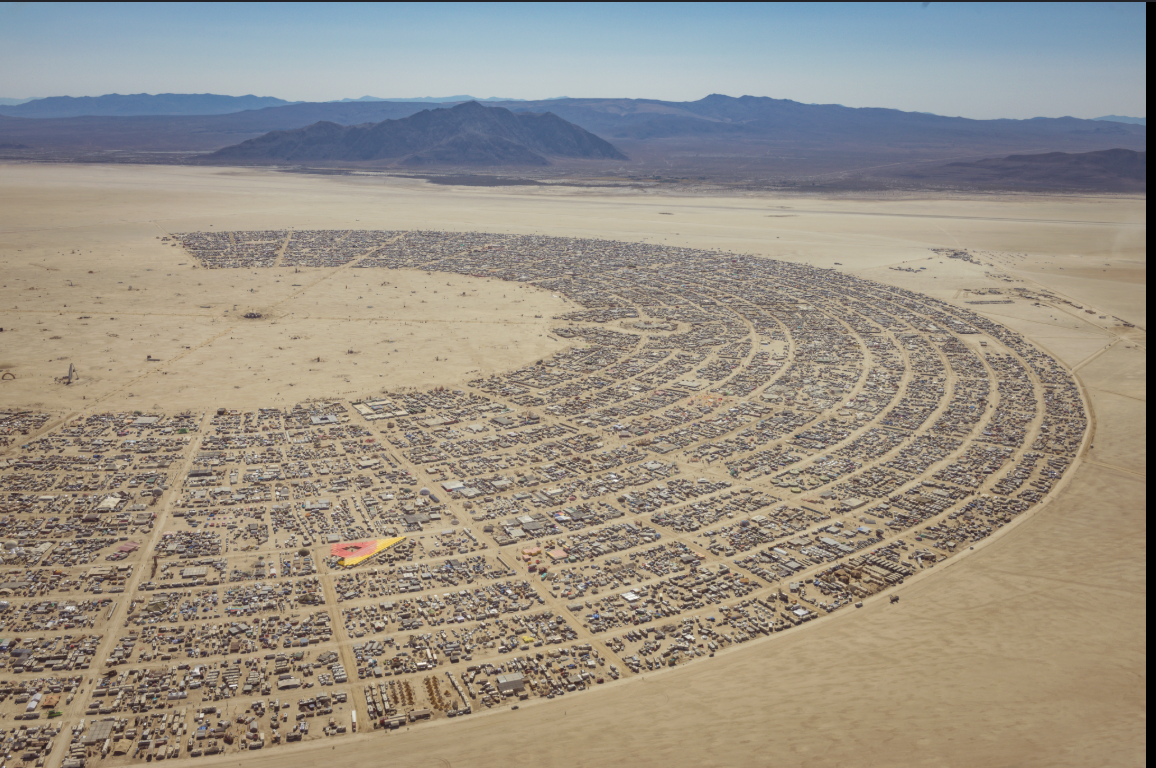
Black Rock City is a genuinely hostile test: no grid, no fiber, alkali dust in everything, brutal heat, whiteouts, and tens of thousands of people arriving at once. Most of what we build gets tested in places far kinder than that.
Can one radio hold a city?
A single 20 W node against a temporary city of tens of thousands. We think the coverage math works. We have never proven it at this scale.
What does free demand look like?
When connectivity costs nothing and nobody is metered, how do people actually use it? We have no good data on this, and neither does anyone else.
Does the hardware survive?
Alkali dust is corrosive and gets into sealed enclosures. A week on playa ages equipment like a year anywhere else.
Does the power budget hold?
Solar input against real load, through cold nights and a multi-day whiteout, with no generator to fall back on.
Where does it actually reach?
Modelled propagation and measured propagation are different things. We will be walking the playa with a meter to find out how different.
What would we change?
The most useful output is the list of things we got wrong. That list goes straight into the next deployment for a school or a fire district.
What we think one radio can do.
This is a prediction, not a promise. The rig runs a 20 W cellular radio, and on paper that reaches about five miles over flat open desert — enough for one node at our camp near 4:30 to cover the whole city and well past the trash fence. Real playa propagation is rarely that tidy. We will be measuring it on the ground and publishing what we actually get.
Modelled free-space propagation for a 20 W radio over flat playa with clear line of sight. Real-world range varies with antenna height, terrain, weather, and load. City plan and trash fence shown schematically.
A cell tower that runs on sunlight.
The same rig we deploy for wildfire response and off-grid campuses, hardened for a week of dust. It arrives on a trailer, stands up in hours, runs the whole burn without a generator, and leaves nothing behind.
Solar array
Panels charge the system all day under desert sun, with no fuel hauled in and no generator noise on the open playa.
Lithium storage
A Victron lithium bank carries the tower straight through the night and through a multi-day whiteout with power to spare.
Private 5G core
A full private cellular network on shared spectrum, running its own core on site, independent of every public carrier.
Starlink backhaul
Satellite uplink is the only thing connecting the playa to the outside world, and it needs no ground infrastructure at all.
Dust-hardened
Sealed enclosures, filtered airflow, and cabling built for alkali dust, wind, and the temperature swing between noon and 4am.
Guardian monitored
Every node, battery, and radio reports into one console, watched around the clock by our team back home.
Scan a code. Get connected. Go play.
Come by the rig and we will gift you an eSIM for the week. It installs over the air in about a minute, needs no app and no SIM swap, and puts you on our private network instead of a saturated public one.
1 · Find the tower
Walk up to the rig on playa and scan the QR code posted on the trailer.
2 · Install the eSIM
Your phone downloads the profile over the air. No app, no physical SIM, no swapping anything out.
3 · Join the network
You are on Bright5G private 5G, on capacity we control, not a distant tower shared by the whole desert.
4 · Keep it, or leave it
The profile expires on its own after the burn. Delete it whenever you like, and nothing follows you home.
Built to respect the principles.
We are guests here. The deployment was designed around the culture of the place, not the other way around.
Connectivity is gifted, not sold. There is no tier, no upsell, no signup, and no data harvested from anyone who joins the network.
Solar and battery mean no generator and no fuel. Everything we haul in gets hauled back out, and the rig leaves the lakebed exactly as it found it.
The tower makes its own power, runs its own core, and carries its own backhaul. It depends on nothing that already exists out there.
Coverage is shared with everyone in range. Neighboring camps, art crews, and anyone who wanders up to the trailer are all welcome on it.
If an emergency happens in range, a working network helps. We coordinate with the community and stay out of the way of official channels.
This is a demonstration, not a distraction. Take the signal if it serves you, and put the phone away when it does not.
Everything gets logged.
Solar input, battery reserve, radio health, backhaul, and connected devices all stream into Guardian for the whole week. That log is the actual output of this experiment — the power curve under real load, the demand pattern, and every fault, recorded as it happens rather than reconstructed afterward.
It is the same console that runs private networks for schools, marinas, and wildfire response. The playa is just the harshest place we have ever pointed it at, which is precisely why the data is worth having.
Explore the Guardian platform →Representative Guardian Command view, shown with sample site data.
Register for an eSIM.
Placement gets confirmed closer to the burn. Register for your eSIM below and we will send the QR code, our exact location, and a heads-up the day we go live.
On playa
Bring a phone that supports eSIM. Most handsets from the last few years do.
Reserve your eSIM
Register now and we will send your eSIM QR code, our placement, and go-live timing before gates open. Free, gifted, no account.
We will publish what we learn.
Coverage we measured against coverage we modelled, the power curve under real load, peak concurrent devices, every failure and what caused it. It goes up on this page after the dust settles, including the parts that did not work. If it holds out there, we will know why. If it does not, that is the more useful result.